

When I was helping artists prep for our local arts festivals, I noticed a pattern: the makers who sold out were not always the ones with the fanciest displays. They were the ones whose words matched their work. Their tags, blurbs, and little handwritten notes felt steady. Chosen. Like the piece had a point of view.
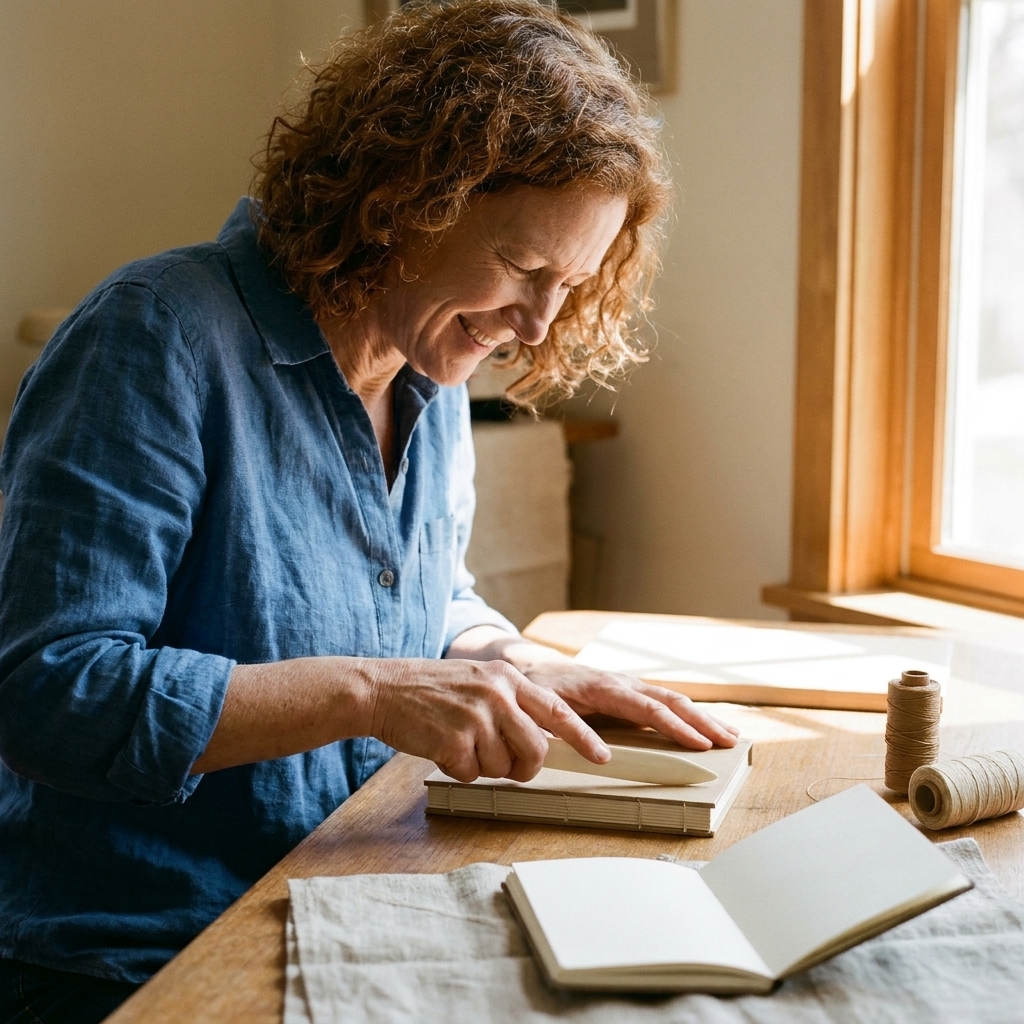
That is often what people mean when they say a journal or book feels intentional. Not stiff. Not overly serious. Just made on purpose, with decisions you can feel in the spine, the paper, and the phrasing.
What “intentional” means
Intentional means done on purpose, guided by a clear aim rather than habit, hurry, or default choices. In everyday use, it also carries a sense of careful selection: you thought about what you were doing, and you meant to do it that way.
If you like a more maker-friendly definition, here is the one I come back to when I am writing product copy or a dedication page:
Intentionality is the practice of choosing with awareness, then following through with consistency.
That second half matters for handmade journals and bindings. Intentionality is not only a feeling at the start. It shows up in follow-through: the consistent stitching, the measured margins, the steady tone in your words.
Intentional vs. mindful vs. deliberate
These get used interchangeably, and in real life they overlap. Still, they lean in slightly different directions:
- Intentional: purpose-led. Emphasizes why you chose something.
- Mindful: present and attentive. Emphasizes how you are paying attention in the moment.
- Deliberate: careful and unhurried. Emphasizes pace and control in the choice.
On a cover stamp or a tiny colophon line, any of the three can work. The best pick depends on the mood of the book.
If you want more vocabulary like this across topics, start with Word Meanings.
Words that carry intentionality
If you are adding custom text to a mindfulness journal, a bookplate, or a maker’s note, you rarely need to say “intentional” outright. Often, the more convincing move is to use neighboring words that demonstrate intentionality.
Words that signal purpose
- purposeful: actively guided by a goal
- directed: aimed toward something specific
- goal-oriented: practical, measurable, forward-moving
- values-led: guided by a clear set of values
- for a reason: plainspoken, quietly confident
Best for: project descriptions, product cards, about pages, and inside-cover blurbs.
Words that signal care and selection
- considered: thoughtfully chosen, not impulsive
- curated: selected with a guiding taste or theme
- edited: simplified on purpose, distractions removed
- refined: improved through careful adjustment
- handpicked: warm, human, maker-to-maker
Best for: paper descriptions, material choices, minimal cover text.
Words that signal steadiness and follow-through
- consistent: reliable decisions repeated with care
- disciplined: held to a standard
- devoted: emotionally committed, loyal to the practice
- grounded: steady, anchored, not performative
- ritual-like: repeatable in a meaningful way
Best for: guided journals, habit trackers, long-term practice notebooks.
Words that signal values
- aligned: choices match the values
- ethical: choices consider impact
- gentle: supportive rather than harsh or punishing
- honest: plain truth, no extra gloss
- human: compassionate, plainspoken self-talk
A note from the practical side: value words like ethical only land well if you can point to what makes them true (materials, sourcing, labor, or packaging choices). If you cannot substantiate it, choose a lighter word that you can.
This is where intentionality becomes more than aesthetics. It becomes a relationship between the maker, the user, and the daily life the book is meant to hold.

Short phrases for a journal
When space is tight, you want language that feels grounded, not slogany. Here are options that work on covers, belly bands, bookplates, and first pages. Use them as-is or as a starting point for your own voice.
Cover or spine phrases
- On purpose.
- Made with care.
- Keep it simple.
- Return to center.
- Small steps, often.
- Steady over perfect.
- What matters, daily.
Inside-cover lines
- This book is for noticing.
- Write what is true today.
- Choose one honest sentence.
- Make space. Then fill it gently.
- Let this be a place you can return to.
Maker’s note or colophon tone
- Bound slowly, so you can write slowly.
- Materials chosen for softness, strength, and longevity.
- Designed to hold ordinary days with care.
- Minimal by design, so your words have room.
If you are trying to keep your phrasing clear and readable on small formats, this pairs well with Write Clear Words for a Small Sign. Different object, same constraint: few words, high stakes.
Make it specific
Here is the fastest way to make “intentional” feel real: replace abstract praise with a specific decision.
Less convincing: “An intentional journal for mindful living.”
More convincing: “Wide margins for breathing room, a soft lay-flat binding, and undated pages so you can come back without guilt.”
Try this mini formula when you write product descriptions:
- Value: what you want the user to feel (calm, clarity, courage, steadiness)
- Decision: the design choice that supports it (paper weight, page count, ruling style, cover texture)
- Result: what that choice makes easier (daily writing, reflection, planning, remembering)
A quick revision example
Before: “A curated, intentional notebook for your mindful routine.”
After: “A pared back notebook with thick, ink-friendly pages and a simple layout, made for one page a day. No dates, no pressure, just space that stays open for you.”
Examples you can borrow
- Grounded because the pages are undated and forgiving.
- Considered because the prompts are few, not noisy.
- Purposeful because each section has a job: notes, reflection, and next steps.
- Refined because there is nothing on the page that does not serve your words.
When to skip “intentional”
I like the word, but it is not always the best tool. I skip “intentional” in listings when:
- I cannot name the decision. If you cannot point to one concrete choice, the word will float.
- I am stacking buzzwords. “Intentional, mindful, curated, elevated” tends to cancel itself out. Pick one and earn it with details.
- The vibe is simple and practical. Sometimes “simple,” “sturdy,” “made to last,” or “kept plain on purpose” is a better match.
- The claim needs proof. If you mean “ethical” or “sustainably made,” be ready to say what you did, not just what you are.
Common misreads
Sometimes “intentional” lands wrong, especially in wellness spaces. If your audience is a little allergic to buzzwords, watch for these traps.
1) It can sound performative
If your copy feels like it is trying to prove something, switch to plainer language: simple, steady, clear, made to last.
2) It can sound rigid
Some people hear intentionality as strict routines. If your journal is gentle, say so with words like flexible, open-ended, roomy, forgiving, at your pace.
3) It can sound vague
If you could swap your sentence onto any product, it is too vague. Anchor it to one detail: the binding style, the paper, the structure, the prompts, the blank space.
Word list by mood
When you are naming a collection, writing a belly band, or choosing a foil stamp, it helps to pick a consistent mood and stay there.
Quiet and minimal
- spare
- clean
- uncluttered
- pared back
- essential
Warm and human
- tender
- gentle
- kind
- welcoming
- companionable
Steady and resilient
- anchored
- sturdy
- constant
- enduring
- trustworthy
Focused and forward-moving
- clear
- direct
- decisive
- committed
- next right step
If you enjoy words that carry coziness and steadiness without getting sugary, you might also like The True Meaning of Hygge. Hygge is not the same as intentionality, but they overlap in that chosen-atmosphere feeling.
FAQ
Is “intentional” a synonym for “mindful”?
Not exactly. Mindful emphasizes attention in the moment. Intentional emphasizes purpose and choice. A journal can be intentional in design even if the user is not feeling especially mindful that day.
What word is better than “intentional” for product listings?
Try considered, purposeful, thoughtful, or carefully made. If you can, pair the word with one specific detail so it does not float.
How do I write intentional copy without sounding preachy?
Use inviting language rather than instructive language. “A place to return to” tends to land better than “You should write every day.” Keep the tone roomy and optional.
What is one sentence that communicates intentionality fast?
“Every element is here for a reason, and nothing is here by accident.” If that feels too formal, soften it: “Kept simple on purpose.”
One last nudge
Intentionality is not the same as intensity. Some of the most intentional books I have held were almost plain: good paper, a steady stitch, a quiet cover, one honest line inside. If you are unsure what to write on your handmade mindfulness journal, start with the simplest true thing about it. Then let the materials do the rest.
If you ever want the broader language difference between maker terms, I keep a running guide to nuance on Bespoke vs. Custom vs. Handmade. The words we choose shape expectations, and expectations shape how someone receives your work.