

At my first local arts festival volunteer shift, I watched a maker with gorgeous ceramics lose customer after customer for one simple reason: nobody knew what the pieces were, how much they cost, or why they were special. Her table was beautiful. Her work was strong. Her sign said something like “Good Vibes Only” in perfect script, which is sweet, but not helpful.
A tabletop chalkboard is tiny real estate, but it can do big work for you. The best chalkboard signs at maker markets do three things at once: they invite, they clarify, and they guide. Here is how to craft catchphrases that feel warm and human, while still answering the questions shoppers are already thinking.
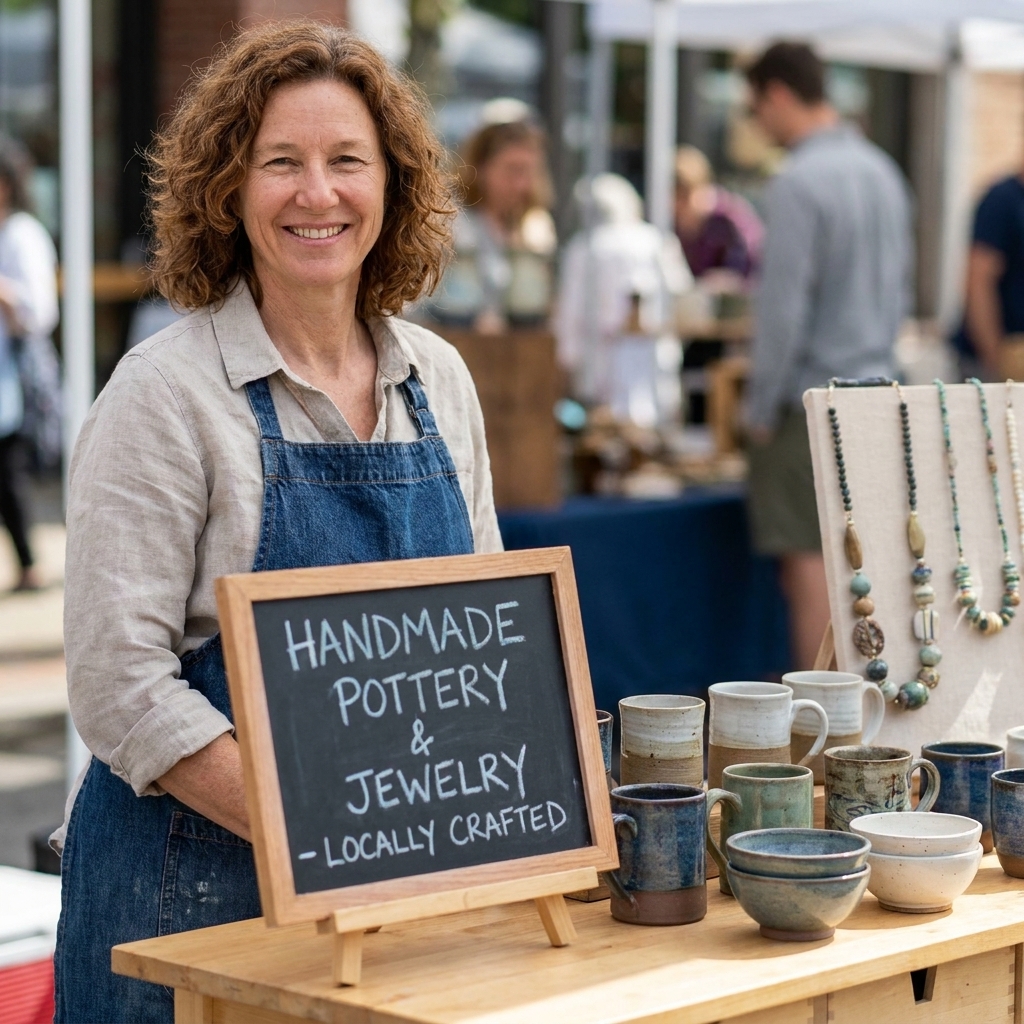
The three questions your sign must answer
Most shoppers do the same little loop at a booth: they glance, they lean in, they decide whether to ask. Your chalkboard can shorten that loop by answering three questions before anyone has to do the awkward “hi, what is this?” moment.
- What is this? Name the product in plain words.
- What does it cost? Give a starting point, a range, or a clear “most items” price.
- What should I do next? Touch, smell, flip through, ask for sizing, request a custom color, and so on.
If you only have room for one sentence, pick clarity over cleverness. In my experience, “Hand-poured soy candles, $12 and up” tends to move more product than “Make it cozy,” because it removes the two biggest questions right away.
Your goal is not to describe everything. It is to remove friction. Give people just enough to understand what you sell and what to do next, without making them work for it.
Catchphrase formulas that work
I love a charming phrase as much as anyone, but at a market you earn charm by being helpful. These are the formulas I see working over and over, across different crafts.
Name + benefit
Use when: your product needs a quick “why.”
- “Small-batch body butter for dry winter hands”
- “Everyday studs that do not snag sweaters”
- “Durable, everyday mugs for real coffee people”
Category + price anchor
Use when: shoppers are price-checking fast.
- “Stickers $3, mini prints $8”
- “Handmade soaps, 3 for $18”
- “Earrings from $16”
Origin story in one line
Use when: your process is your differentiator.
- “Wheel-thrown here in town, glazed by hand”
- “Linocut prints pulled one at a time”
- “Refinished vintage frames, each one rescued”
Easy gift cue
Use when: you want browsers to become buyers.
- “Gifts under $25, right this way”
- “Teacher gifts, grab-and-go”
- “Little luxuries for care packages”
If you sell a lot of giftable items, pairing this with a small labeled section on your table helps. If you need quote ideas for specific gift categories, you might also like these teacher appreciation quotes and these comforting pet memorial quotes.
Examples by booth type
Below are sign lines you can copy as-is or tweak. The goal is not perfection. The goal is that a stranger understands you in three seconds.
One note before you borrow: pick lines you can fully deliver on. If you do not offer same-day personalization or you do not label something as dishwasher-safe, swap in a version that fits your workflow.
Ceramics
- “Wheel-thrown stoneware mugs, $28”
- “Bowls and planters, $18 to $65”
- “Ask me about custom colors for sets”
Candles and fragrance
- “Soy candles poured in small batches, $12 and up”
- “Smell test encouraged. Favorites on the top shelf”
- “Seasonal scents, limited run”
Jewelry
- “Nickel-free options available, just ask”
- “Earrings from $16. Necklaces from $28”
- “Initial and birthstone pieces, ask what I can personalize today”
Prints, stickers, paper goods
- “Stickers $3, 4 for $10”
- “Original illustrations. Prints signed on request”
- “Flip through the print bins, there’s more than what’s on the wall”
Textiles, crochet, quilts
- “Baby gifts: blankets, loveys, and keepsakes”
- “Touch everything. It is meant to be held”
- “Custom colors available for made-to-order pieces”
If you want sweet, short lines for textile tags and labels, these baby quilt label sayings can also double as mini display sign ideas.
Layout that reads fast
A chalkboard sign is not a poster. It is a glance tool. Here is the structure I recommend when space is tight.
- Line 1: product category in big letters. Example: “HANDMADE SOAPS.”
- Line 2: price anchor. Example: “$7 each, 3 for $18.”
- Line 3: one differentiator. Example: “Gentle, palm-oil-free recipes.”
- Line 4: one action. Example: “Smell, then pick your trio.”
Keep it blocky and readable. Save script for one or two words only, like a header or a single emphasis word. If you want a deeper lettering refresher, this Cricut lettering guide has solid spacing and readability tips that translate well to chalk, too.
When you cannot list exact prices
Sometimes you truly cannot put a single price on a sign. Maybe every piece is one of one, maybe your work is priced by size, or maybe you are mid-restock and the table is changing.
You can still give people an anchor without locking yourself in:
- “Most items $12 to $40”
- “Small goods $6 to $18. Statement pieces $45 and up”
- “Prices on tags. Ask about bundle deals”
- “Custom pricing by size. Tell me your budget”
The point is to tell shoppers whether you are in their ballpark, so they feel comfortable stepping closer.
Legibility basics
The best wording in the world will not help if the sign is hard to read. A few low-effort tweaks make a big difference:
- Contrast: white or bright chalk on a clean, dark board reads fastest.
- Letter size: make your first line large enough to read from about five feet away.
- Glare: if you are under harsh lights, tilt the sign slightly so it is not reflecting overhead bulbs straight into someone’s eyes.
- Spacing: leave more empty space than you think you need. Crowding is the fastest way to look “busy.”
Keep it cute, keep it clear
You do not have to choose between personality and clarity. Put the “cute” line in a supporting role and let the helpful line lead.
- Top line: “GOOD VIBES ONLY”
- Second line: “Ceramic mugs, $28”
- Third line: “Pick one up, feel the handle”
The vibe stays, and shoppers still get what they came for: instant understanding.
Guidance phrases that feel friendly
Shoppers like permission. In my experience, a gentle instruction often increases interaction and reduces hovering.
- “Pick up a sample. Feel the weight.”
- “Open the notebook. Try the paper.”
- “Please touch. Everything is meant to be handled.”
- “Ask for sizing help, I have a measuring strip.”
- “Tell me who you are gifting for, I’ll point you to the bestsellers.”
Quick fixes for common sign mistakes
Mistake: too vague
Instead of: “Made with love”
Try: “Handmade knit hats, $32”
Mistake: no price info
Instead of: “New collection”
Try: “New fall studs, $18”
Mistake: too many words
Instead of: “All items on this table are made by me in my home studio with carefully sourced materials and…”
Try: “Made in my home studio. Materials listed on tags.”
Mistake: cute phrase takes the headline spot
Instead of: “Good vibes only”
Try: “Ceramic mugs, $28” with “good vibes only” as a smaller footer line if you still want it.
A simple checklist before the doors open
- From five feet away, can I read the first line?
- In three seconds, do I know what you sell?
- Is there at least one clear price anchor?
- Is there one instruction that gives me permission to interact?
- Is the tone you, not a generic internet voice?
If you hit those five, you will already be ahead of most booths. And if you want to go one step further, make a second tiny chalkboard that rotates through specifics: “Bestsellers,” “Giftable under $25,” “Custom orders open,” or “Last chance, seasonal scents.” One sign invites. The other helps people decide.