

I have a soft spot for words that feel like a tiny lantern. You pick them up, and suddenly you can see your own work more clearly.
Meraki is one of those words. Makers use it to mean “made with soul,” but it is worth slowing down and getting precise. When you understand what meraki is pointing to, it becomes more than a pretty caption. It becomes a clean, honest way to describe how and why you make.
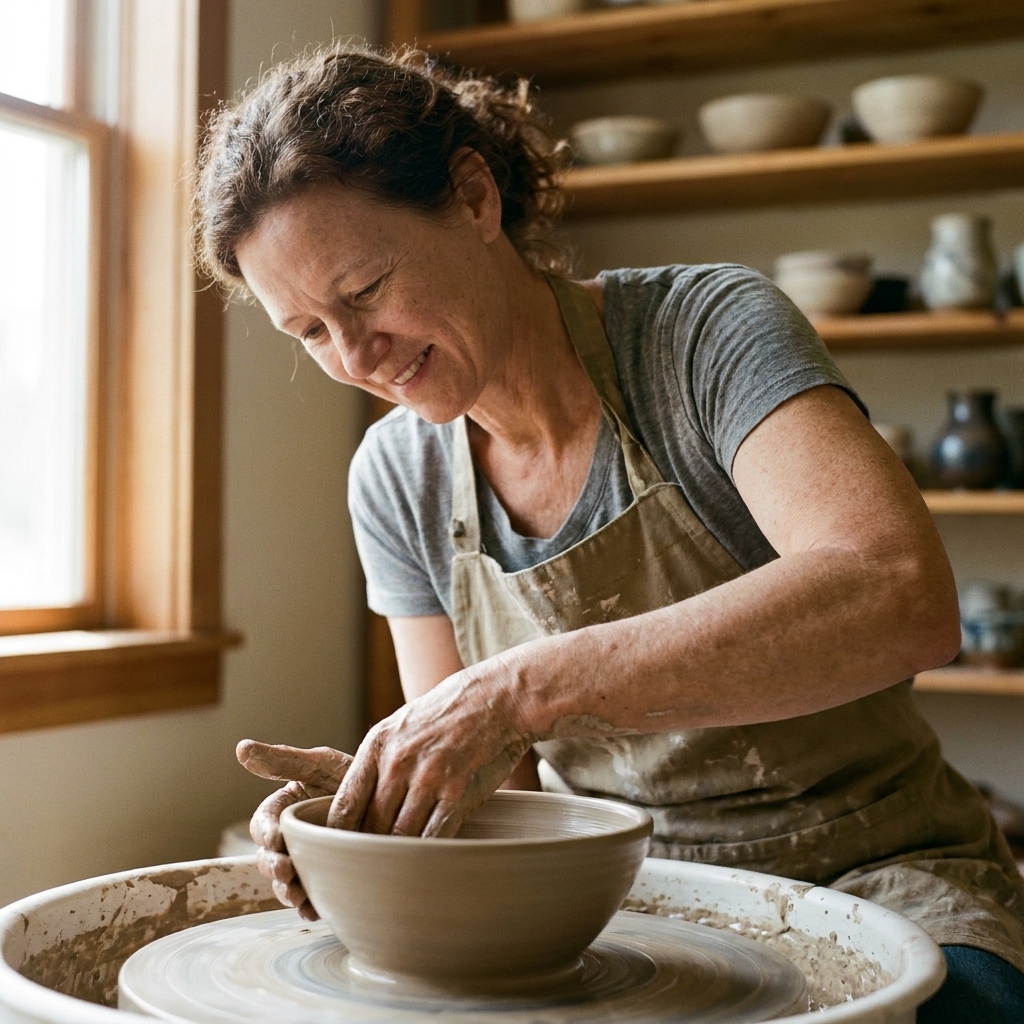
What does meraki mean?
Meraki (μεράκι) is a Greek word used to describe doing something with care, creativity, love, and personal investment. In plain language: you put something of yourself into what you are making.
People often explain it as leaving “a piece of yourself” in the work. Not in a dramatic way, but in the everyday-maker way: care in the choices, attention to detail, patience with the process, and pride that comes from doing it thoughtfully.
Meraki is not just “handmade”
One useful branding distinction is this:
- Handmade tells me how it was produced.
- Meraki tells me how you showed up while producing it.
A piece can be handmade quickly and carelessly. A piece can also be made with meraki even if a tool, machine, or small studio team is involved, because the defining feature is the maker’s intention and attentiveness.
If you enjoy word-meaning deep dives like this, the Word Meanings guide collects more of them.
Pronunciation and spelling
Pronunciation: often rendered in English as meh-RAH-kee (stress is usually on the middle syllable).
Spelling: meraki
Two quick notes for your shop listings and captions:
- Plural forms are possible, but in English marketing copy it often reads more naturally to keep it unpluralized. “Meraki pieces” or “made with meraki” usually reads more smoothly than “merakis.”
- Avoid turning it into a vague adjective. “Meraki vibes” can be fun on social, but on product pages it can feel slippery unless you follow with something concrete. For example: instead of “meraki vibes,” try “hand-finished edges, tight seams, and hardware I would trust on my own bag.”
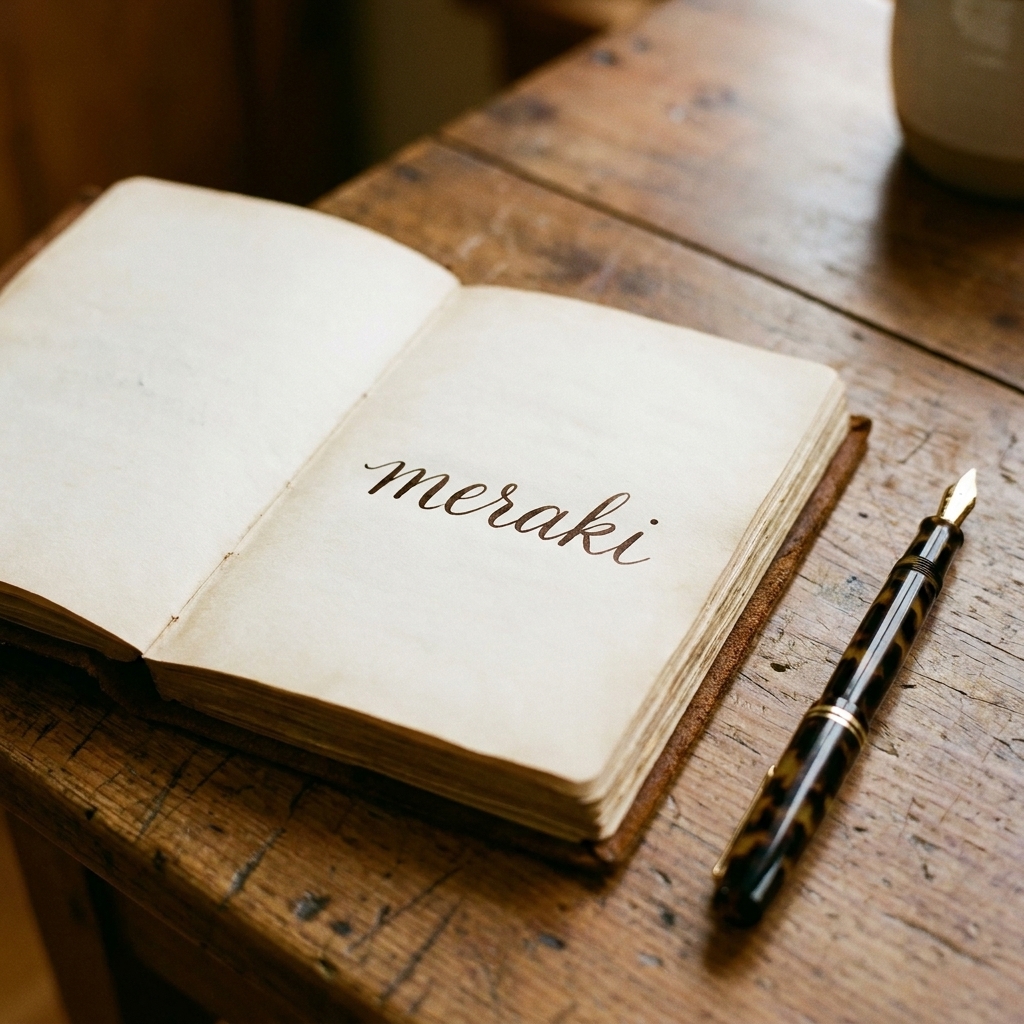
Where meraki comes from
Meraki is a living, everyday Greek word, not a new invention from the internet. You will see it used for cooking, decorating, hosting, building, music, and craft. It speaks to the maker’s mindset.
You will also sometimes see notes that Greek meraki is related to the Turkish word merak, about curiosity or passionate interest. Language history can be messy, but the modern Greek usage is what matters most for how the word lands today.
That background matters for branding because it helps you use the word with respect and specificity. Meraki works best when you treat it as a meaningful concept, not as an exotic “aesthetic.”
If you want a quick reputable reference on the Greek term itself, Merriam-Webster includes an entry: https://www.merriam-webster.com/dictionary/meraki.
Meraki in everyday Greek
If you have only seen meraki on Instagram, it helps to see what it looks like as an ordinary word, too. You might hear someone say:
- Το έφτιαξα με μεράκι. “I made it with care and love.”
- Μαγειρεύει με μεράκι. “She cooks with real care and devotion.”
Even in translation, you can feel it: it is about the spirit you bring to the work, not just the category of the work.
Meraki vs. similar words
Meraki overlaps with a few other popular “maker words,” but they are not interchangeable. Here is a simple way to choose.
- Meraki: you put part of yourself into the work. Emphasis on personal devotion and care.
- Artisan: emphasis on skilled craft and often tradition.
- Intentional: emphasis on deliberate choices and purpose.
- Thoughtful: emphasis on consideration for the user, gift recipient, or experience.
- Heirloom: emphasis on longevity and being worth keeping.
One more close cousin is hygge, which gets used in a similar lifestyle shorthand way. If you have ever wondered what that one really means, you might like the true meaning of hygge.
Using meraki in branding
I see meraki used in three common places: about pages, product descriptions, and social captions. It can work in any of them, but only if you attach it to something tangible.
1) Put meraki in your brand story
Meraki fits beautifully on an About page when you use it as a bridge between your values and your process.
Try this structure:
- Name the care: “I make every piece with meraki.”
- Prove it: mention 1 to 3 real decisions you make (materials, time, finishing, testing, packaging, customization).
- Connect it to the customer: what does your care do for them?
Example: “I sew each bag with meraki, taking time to reinforce stress points, match patterns carefully, and finish every seam cleanly so it holds up to daily use.”
2) Use it as a “why” sentence in listings
Product descriptions are where meraki often gets dropped in as a stand-alone claim. Instead, use it as a one-sentence explanation for what makes your work different.
Better than: “Made with meraki.”
Try: “Made with meraki, from the first sketch to the final polish, so the details feel as considered as the overall design.”
If you want your listings to be easy to read (and not overly poetic), I wrote a practical piece on making words do real work on small surfaces: write clear words for a small sign. The same clarity rules apply to labels, hang tags, and product cards.
3) Let it guide your tone
Meraki is not only a word you insert. It is also a standard you can apply to your copy:
- Write like a person, not a catalog.
- Name what you actually did.
- Be specific about the sensory details that matter: texture, weight, finish, scent, sound.
- Say fewer things, but make them true.
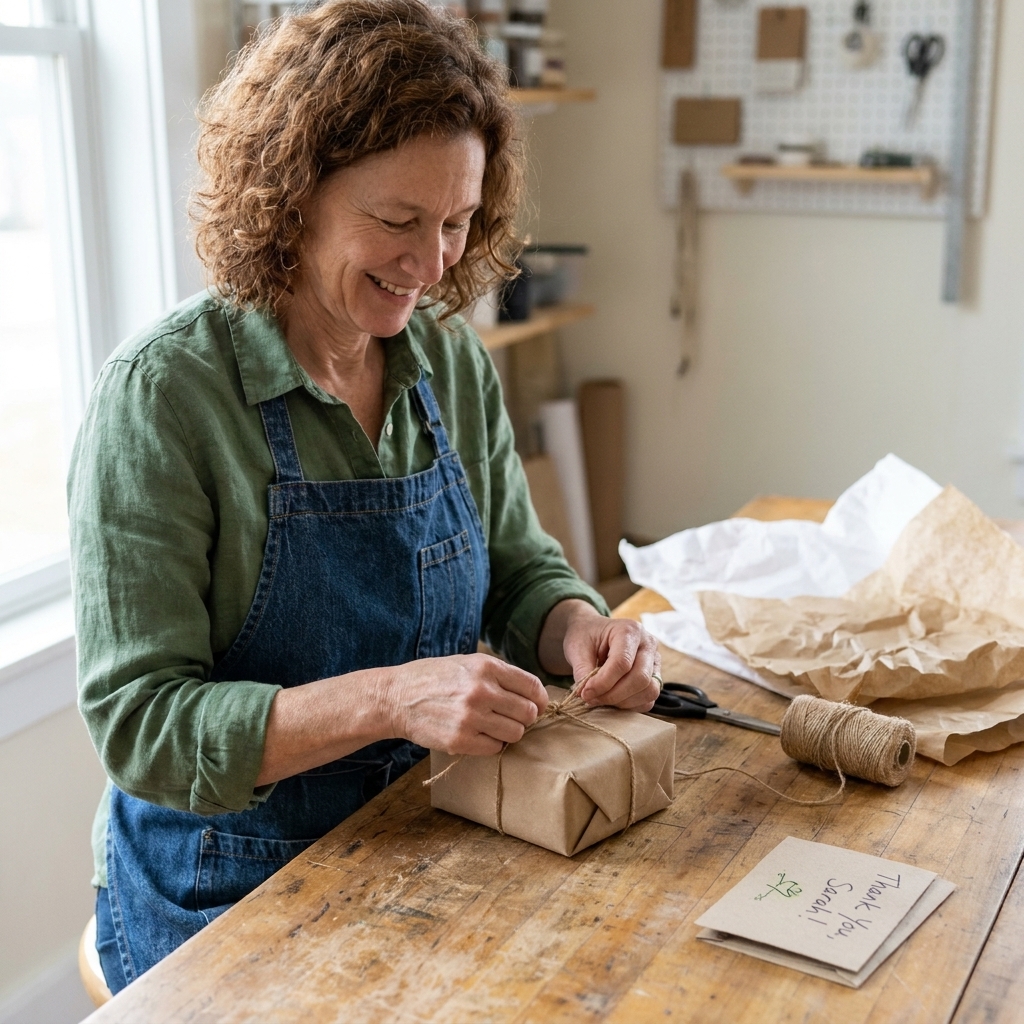
Meraki phrases to adapt
Use these as jumping-off points, then swap in your real materials, techniques, and promises. (Meraki is strongest when it lands on specifics.)
- “Made with meraki, finished slowly, and checked twice before it reaches you.”
- “Every stitch is guided by meraki and a love of durable, everyday design.”
- “I work with meraki, choosing materials that feel good in the hand and last in the home.”
- “Designed with meraki for the moments you actually live in.”
- “From first draft to final glaze, this piece was shaped with meraki and patience.”
- “A small-batch process powered by meraki, strong coffee, and attention to detail.”
If you need more ready-to-use lines for packaging, signs, and maker bios, browse the Quotes and Sayings guide.
Common mistakes
Mistake: Using meraki instead of quality
Fix: Pair it with a concrete marker of quality: seam finishes, hardware grade, paper weight, kiln schedule, test washes, sanding steps, or whatever “care” looks like in your medium.
Mistake: Making it your only brand word
Fix: Let meraki support your brand, not replace it. Your brand still needs a point of view: playful, minimal, nostalgic, bold, nature-inspired, modern heirloom, and so on.
Mistake: Treating it like an aesthetic label
Fix: Use it as a process word. When you connect it to your process, it reads as grounded and respectful.
A quick respect check
If you use meraki in your branding, keep it simple and honest:
- Do not imply Greek heritage or a Greek backstory you do not actually have.
- Use it as a concept (care, devotion, pride in craft), not as borrowed identity.
- When in doubt, pair the word with specifics from your own process so it earns its place.
Meraki check
Before you hit publish, scan your copy with these five questions:
- Where is the human in this? Did you mention your hands, your time, or your decision-making?
- What did you do slowly on purpose?
- What detail would a careful customer notice?
- What does this care change for the buyer? Comfort, durability, fit, meaning, ease, delight?
- Did you earn the word meraki? If you removed it, would the description still show care?
FAQ
Is meraki only for art?
No. In Greek usage, it applies to cooking, hosting, arranging a home, gardening, building, learning, and craft. For branding, it fits any maker business where care and personal investment are genuinely part of the process.
Can I use meraki in my business name?
You can, but consider longevity and clarity. “Meraki” in a name is beautiful, but it is also widely used. If you choose it, pair it with something distinctive: your medium, your place, your signature motif, or your own name.
Does meraki mean “putting your soul into something” literally?
Not in a strict, dictionary-literal sense. It is closer to “doing something with love, pride, and creative devotion.” The “soul” phrasing is a popular English explanation that captures the feeling, even if it is poetic.
What is a good alternative if meraki feels too trendy?
Try “made with care,” “made with intention,” “slow-made,” “small-batch,” or “thoughtfully crafted,” then back it up with one specific process detail. Clear beats clever almost every time.
A practical way to think about meraki
Meraki is not a claim you slap on the end of a sentence. It is a promise about your attention.
If you can name where you slowed down, where you chose quality, and where you made a decision for the person on the other side of the purchase, you are already doing meraki. The word just gives you a clean way to say it.
If you are curious about the person behind AllWords, you can find me here: /author/audrey-lockwood/.