

When I was helping artists prep for our local arts festivals, I noticed something funny. The most productive booths were rarely the biggest or fanciest. They were the ones where the maker had a simple, steady rhythm. A little system. A tiny reminder. Something that brought them back to focus.
A one-word desk mantra does the same thing for a home office. It is not there to shame you into hustling. It can give your brain a clean handle to grab when your attention starts to slide. The best ones feel like a gentle nudge and a clear boundary at the same time.

What a one-word mantra does
In a home office, motivation is not usually the problem. Friction is. The word on your desk is a friction-reducer. It shortens the conversation you would otherwise have with yourself.
- It names your intention. Not your entire personality, just what you are practicing today.
- It sets a filter. When a task comes in, you can ask: does this support the word?
- It offers a reset cue. When you feel scattered, the word is a quick way back.
If you like thinking in terms of purpose and clarity, you might also enjoy my piece on defining intentionality for projects. The same idea applies here, just in desk-sign form.
How to choose your word
Step 1: Pick the work mood you want
This is the biggest mistake I see. If you feel chaotic, your word does not have to be “Chaos” (or even “Calm”). “Calm” is lovely, but it can be so broad that it does not tell you what to do next. Often, a more workable word is something with a little grip to it: “Steady,” “Simplify,” “Begin,” “Finish.”
One example: Steady can mean one tab, one task, one timer session (about 20 to 30 minutes), then a quick reset.
Step 2: Choose an action cue or a character cue
- Action cues tell you what to do next: Draft, Focus, Decide, Ship.
- Character cues tell you how to show up: Patient, Brave, Curious, Honest.
Action cues work beautifully for deadline seasons. Character cues are better when the work is emotionally demanding, like client communication or creative risk.
Step 3: Keep it easy to say at a glance
If you hesitate when you read it, you may be more likely to slide right past it. Words like “Indefatigable” are fun, but they are better in a journal than on a desk plaque. Choose something you can say out loud in one beat.
Step 4: Make sure the word has a “do” attached
A desk mantra should translate into behavior. Before you commit, finish this sentence: “If my word is _____, then today I will _____.”
- Focus → close extra tabs and do one thing for one timer session (about 20 to 30 minutes).
- Simplify → cut the task down to the smallest next step.
- Decide → choose a direction and stop reopening the question.
Step 5: Avoid words that feel like a scolding
Some words look motivating but land like a tight jaw: Grind, Hustle, Dominate. If you tense up when you read it, you will either ignore it or resent it.
I like words that feel both kind and firm: Steady, Enough, Boundaries, Clarity.
Quick word picker
If you want help choosing without overthinking, start here. Find the scenario that sounds like your day and borrow a word.
- Meetings all day: Boundaries (protect time), Decide (reduce looping).
- Distracted by tabs and pings: Single (one thing), Quiet (lower the noise).
- Client work and communication: Clarity (say it cleanly), Honest (no overpromising).
- Creative work that feels tender: Brave (show up anyway), Explore (stay curious).
- Admin and follow-through day: Close (finish loops), Complete (make it real).
- Overworking and cannot shut it off: Enough (stop), Offline (end the day).
35 one-word desk mantras
Here are options I have seen people actually keep on their desks, not just pin once and forget. I grouped them by what they are best at.
For focus and deep work
- Focus
- Now
- Single
- Immerse
- Attention
- Quiet
- Anchor
For starting (especially when you are stuck)
- Begin
- Draft
- Try
- Make
- Messy
- Explore
For finishing and follow-through
- Finish
- Complete
- Deliver
- Ship
- Close
- Done
For clarity and decision-making
- Decide
- Choose
- Clarity
- Simplify
- Essential
- Prioritize
For steadiness and resilience
- Steady
- Patience
- Breathe
- Brave
- Persist
- Recover
For boundaries and healthy productivity
- Enough
- Boundaries
- Rest
- Balance
- Offline
If you enjoy one-word formats, you might also like my roundup of single words that work well on conversation starter coasters. Different context, same principle: one word can carry a lot of intention.
Match the word to the sign
Not all desk signs read the same way. The physical format can make a word feel calmer, sharper, or more playful.
Small freestanding plaques
- Best word types: 3 to 8 letters, high-frequency words, no hyphens
- Great picks: Focus, Begin, Steady, Clarity, Enough, Decide
- Quick sizing cue: make the letters large enough to read from where you sit without leaning in.
Long narrow desk rails
- Best word types: slightly longer words that still scan fast
- Great picks: Prioritize, Simplify, Attention, Complete
- Quick sizing cue: prioritize letter height over fancy details so the word reads in one glance.
Minimalist acrylic blocks or metal stands
- Best word types: words that look strong in all-caps
- Great picks: NOW, SHIP, DONE, QUIET
- Quick sizing cue: go bolder than you think, especially if the sign sits below your monitor line.

Design tips for readability
Keep the typography honest
A desk mantra is not a wedding invitation. Choose a style that matches the job the word is doing.
- For urgency and momentum: clean, simple lettering with strong contrast
- For calm and steadiness: softer shapes and slightly wider spacing
- For creative play: a hand-lettered look, as long as it is still legible
If you are making the sign with a cutting machine, these guides can help you avoid the tiny-letter headaches that make people quit halfway through:
Choose a finish that fits your attention style
- Easily distracted? Matte finishes can help. Glare can make the word harder to read, which can make your mantra fade into the background.
- Need a stronger snap into focus? Use high contrast, like dark letters on a light surface.
- Love a softer desk vibe? Choose tone-on-tone, where the word is present but not loud.
Use spacing like a volume knob
Tight spacing can feel intense. Wider spacing often feels calmer and more breathable. If your word is “Breathe,” give it room to breathe.
Where to place it
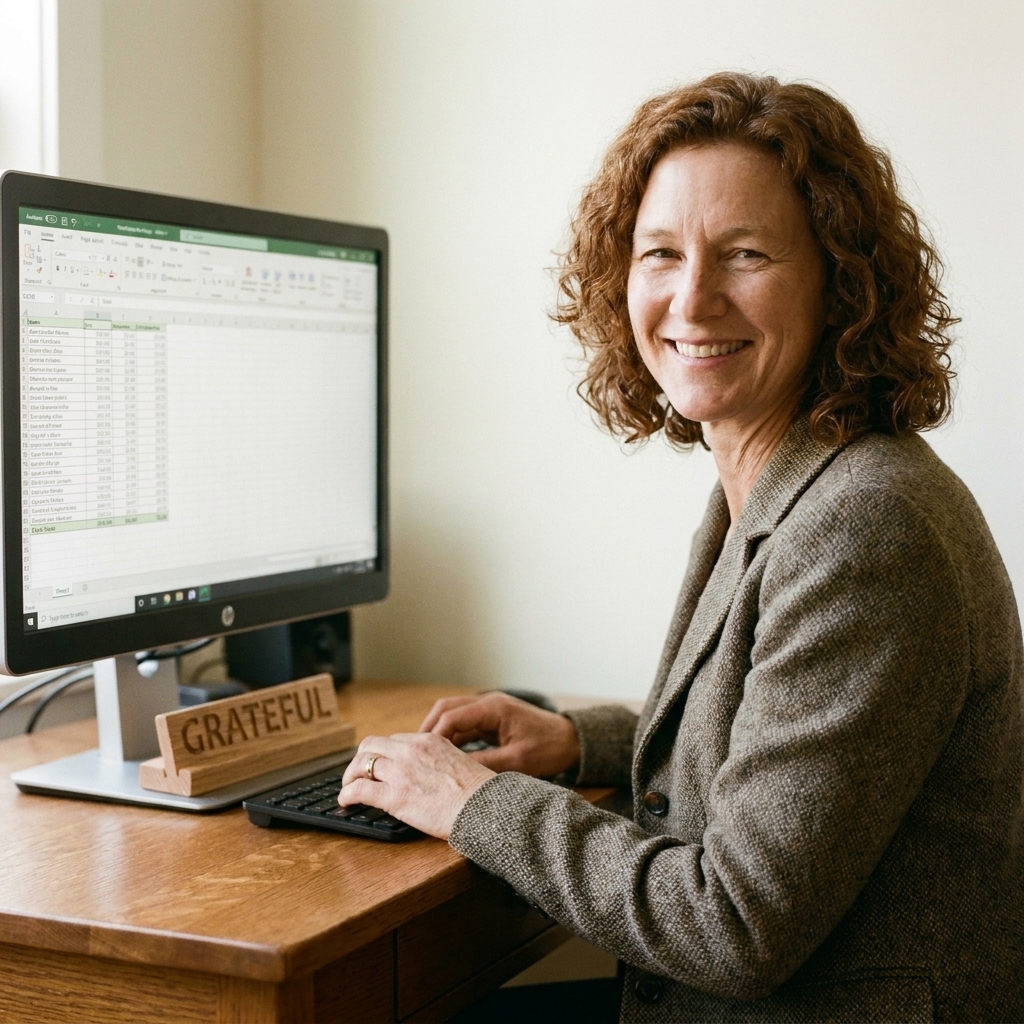
The goal is not to decorate your desk. The goal is to catch your eye at the exact moment you tend to drift.
- Next to your mouse or trackpad if you lose time online.
- Between keyboard and monitor if you forget your priority the minute you open email.
- Near your notebook if your day depends on writing the next step down.
- At the edge of the desk if you need a boundary word like “Enough” or “Offline” to end the day.
How to rotate your mantra
I like a rhythm that is predictable enough to be useful, but not so rigid it becomes another task.
- Monday: Choose a word for the week (Steady, Prioritize, Finish).
- Midweek check-in: If the word is not working, swap it without guilt.
- Friday: Choose a closing word (Complete, Close, Enough) to help you land the plane.
If you keep changing your word daily, you might be chasing a mood instead of building a pattern. Weekly is often the sweet spot for many people.
Quick FAQ
Should my word be positive only?
It should be constructive. That usually reads as positive, but not necessarily peppy. “No,” “Stop,” and “Boundaries” can be extremely healthy desk words if they reduce overcommitment.
What if the word stops working?
That is normal. A mantra is a tool. When you adapt your workflow, you often need a new cue. If “Focus” becomes background noise, try a more specific action word like “Single” or “Close.”
Is it better to pick a value word or a productivity word?
Pick the kind of support you need most this season. During stressful stretches, values like “Patience” and “Honest” can help prevent spirals. During execution-heavy stretches, action words like “Draft” and “Ship” keep things moving.
Can I use two words?
You can, but it changes the effect. One word is a trigger. Two words are a sentence. If you want a short phrase instead, I keep more options over in the Sign Ideas guide and the Quotes and Sayings guide.
Pick a word you will follow
The best desk mantra is not the one that sounds impressive. It is the one that feels like a steady hand on your shoulder while you do ordinary work on an ordinary day.
If you want a gentle starting point, choose one of these three depending on what you need most right now:
- Begin (if you are stuck)
- Focus (if you are scattered)
- Enough (if you cannot turn work off)
Then place it where your eyes naturally go when you are about to wander. That is where words earn their keep.